
“How long should a Short be?” has no single number. The right length is the shortest one that tells the moment completely. Here is how we decide, and how we split long videos into parts that people actually watch in order.
Start from the moment, not the limit
YouTube allows Shorts up to three minutes and Instagram allows long Reels, but limits are not targets. A Short is judged by how much of it people watch and whether they replay it. Ask: what is the one thing that happens in this clip? Start just before it and end just after.
| Type of clip | Length that usually works |
|---|---|
| A single action (a jump, an overtake, a reveal) | 10–30 seconds |
| A small story with a beginning and an end | 30–60 seconds |
| A tutorial step or explanation | 45–90 seconds |
| A full mini-episode in a series | 60–180 seconds |
Splitting a long video into parts
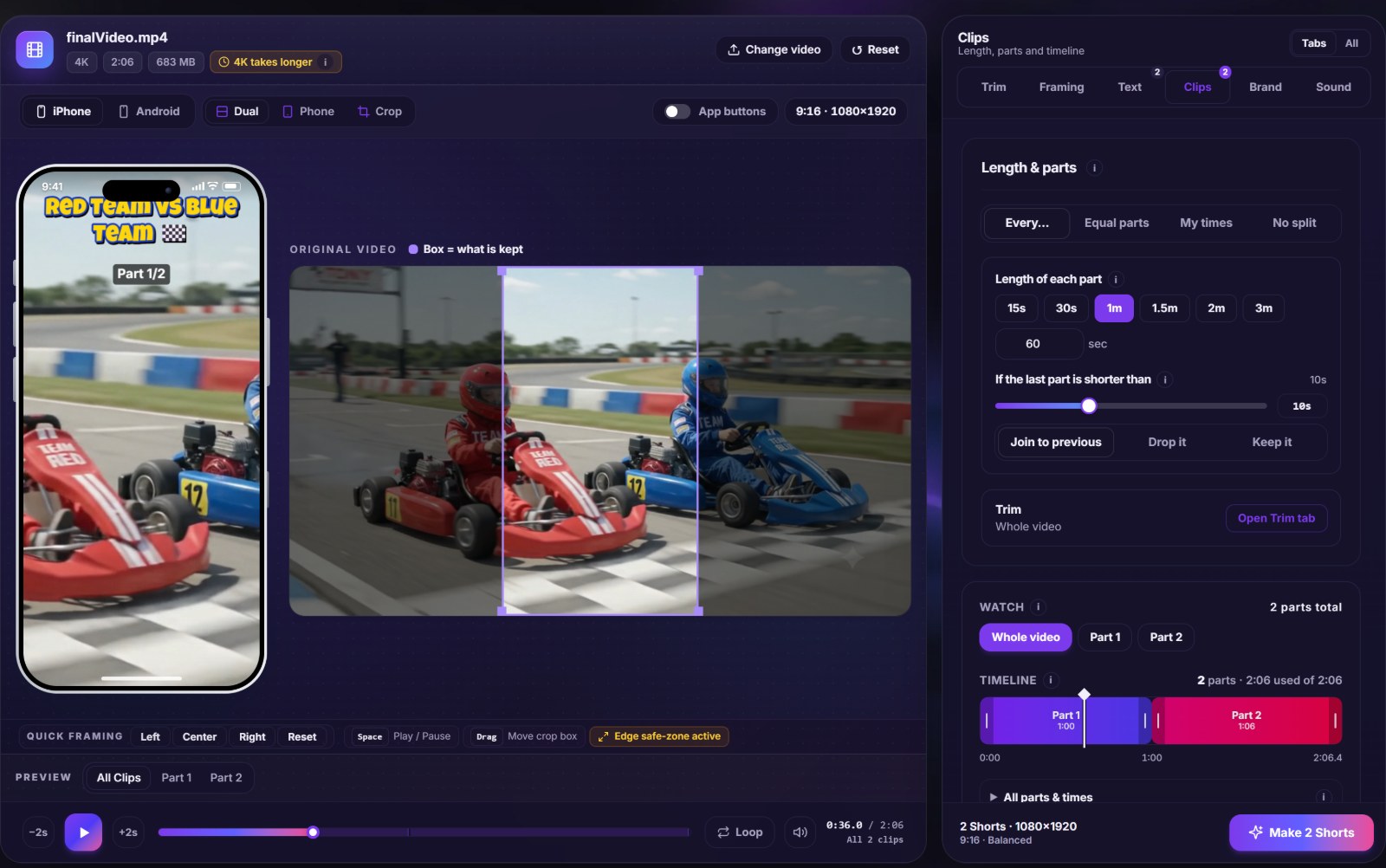
For series (“Part 1/3”) we start with a fixed length and then adjust each cut by hand:
- Choose Every… with a length close to your target, for example 60 seconds.
- Decide what happens to a short leftover. We join anything under 10 seconds to the previous part.
- Play each cut point and move it to a natural break: the end of a sentence, a cut in the original video, a reaction.
- Make sure each part starts strong. If Part 2 opens on the middle of a slow pan, move its start to the next action.
- End each part with a reason to watch the next one, a question or a cliff-hanger, and add a “Part 1/3” label.
Equal parts or fixed length?
Fixed length (Every 60 s) keeps every Short similar, which suits regular uploads. Equal parts (split into 3) suits stories with a clear structure. My times is for highlights: pick only the best ranges and skip the rest.
Posting a series
- Upload parts in order, with the part number in the title.
- Space them out (a few hours to a day) so each gets its own chance.
- Link the parts: pin a comment on Part 1 pointing to Part 2, or use YouTube’s related-video link.